Why the energy industry needs a unified control layer for technical data
Subsurface teams, data managers, IT organizations, and decision makers rely on a growing ecosystem of applications, cloud platforms, and databases - each generating, copying, and modifying enormous volumes of technical data. Yet for all this innovation, one foundational challenge remains largely unsolved: how to create a unified, trusted, and governed view of the technical data estate.
Cenova, Cegal’s next-generation product ecosystem, was built to solve exactly this problem.
Today, most organizations still lack a “single source of truth” for technical data. Despite investing heavily in digitalization, they operate with fragmented data storage environments, disconnected systems, and inconsistent governance frameworks. Subsurface projects live in silos. Wells and seismic data proliferate across shared drives. Reservoir models are duplicated across teams.
The consequences are costly.
According to Splunk (2024), “> 55% of data is ‘dark’” - duplicated files, orphaned projects, and obsolete data sets that nobody owns, but everybody pays for.
Compliance remains a manual process. Integration after mergers and acquisitions can take months. Environmental, social, and governance (ESG) reporting is slowed by unclear data ownership and lineage.
A single control layer for a complex digital estate
Cenova is a modular, enterprise-wide ecosystem for indexing, cataloguing, and governance, which builds an authoritative picture of every technical asset, including seismic surveys, wells, interpretation projects, reservoirs, and simulation models.
Cenova introduces a new concept to the energy sector: a unified control layer spanning the entire technical data landscape. This unified control layer acts as the backbone of an organization’s digital environment. It provides one consistent operating model for discovering, governing, optimizing, and scaling technical data, regardless of its format or location.
Rather than forcing companies to consolidate or migrate data into a single system, Cenova connects to data and applications where they already live, whether that is on premises, in the cloud, or in hybrid environments. Cenova allows companies to understand what data they own, where it lives, how it changes, and how much it costs them.
Why the energy industry needs Cenova now
1. Increasing data volumes
Data is being acquired and generated at an unprecedented speed. Without a unified control layer, this growth becomes unmanageable, resulting in spiralling storage costs, slower decision-making, and compliance risk.
2. Increasing governance demands
With stronger audit requirements, data retention rules, and ESG frameworks, organizations must demonstrate:
- Lineage
- Ownership
- Access controls
- Lifecycle decisions
- Retention and deletion compliance
Cenova embeds governance into the core of the digital estate, providing policy-driven automation and full auditability.
3. Hybrid and multi-cloud adoption
Interoperability is critical when an organization operates across multiple platforms, e.g., Azure, AWS, Google Cloud, OSDU, and on-premises systems. Cenova is cloud- and architecture-agnostic, capable of indexing, analyzing, and governing multi-platform environments from a single interface.
4. AI and automation readiness
AI and ML workflows depend on clean, well-governed data. Companies that lack clarity on metadata, duplication, and quality spend weeks preparing datasets that should be ready in hours. Cenova provides the foundational hygiene layer enabling AI to scale.
The new operating model for technical data
The energy sector is moving rapidly toward a future shaped by automation, AI, cloud adoption, and decision-making driven by big data. Yet without a unified control layer, many organizations remain stuck with the same long-standing challenges: data duplication and fragmentation, governance gaps, and rising complexity across sprawling digital estates.
Subsurface teams interpreting seismic and well information, data managers maintaining standards across massive storage environments, and IT and cloud teams supporting hybrid infrastructures all face a common issue: vital data spread across too many places with too little visibility and control.
Cenova offers a different path (Figure 2). It is designed for these diverse user groups who rely on technical data every day but are constrained by disconnected systems and inconsistent practices. Cenova brings these disciplines together under a single operating model. It provides technical specialists with confidence in the data they use, gives governance teams the clarity they need, and offers decision makers a stable foundation for digitalization, automation, and AI. Ultimately, Cenova is for any organization looking to turn a complex, fast-growing subsurface data estate into a coherent, trusted, and future-ready environment.
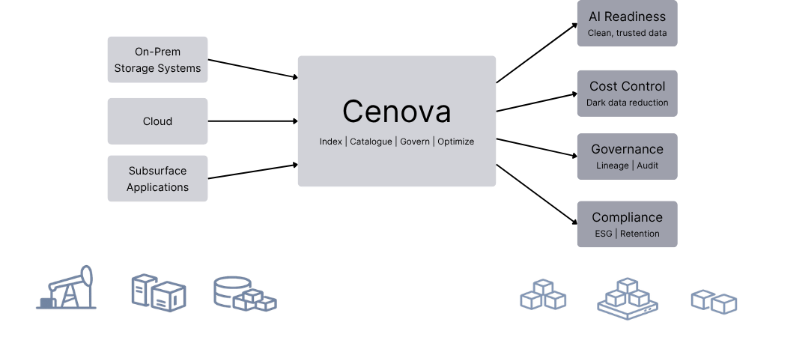
By unifying technical data under a single control layer, Cenova helps organizations:
- Reduce unnecessary storage costs by identifying duplication, orphaned data, and obsolete datasets
- Strengthen governance and compliance through clear ownership, lifecycle control, and auditable policies
- Speed up operational workflows by improving data discovery and reducing manual handovers
- Support ESG and regulatory obligations with consistent metadata, traceability, and retention enforcement
- Prepare for AI and automation by providing clean, trusted, well-governed data
- Simplify complex, hybrid, and multi-cloud data environments through a single, coherent operating model
- Empower users with greater visibility, confidence, and trust in the data they rely on every day.
In an industry where precision, efficiency, and trust are essential, Cenova is more than just another digital tool - it represents a new control layer for the modern technical data landscape.
References: Splunk (2024) State of Dark Data (Industry Survey Report). Splunk Inc., January 2024.
