When deals move faster than data
The E&P industry is consolidating. Acquisitions, divestments, asset swaps and portfolio rationalizations are increasingly happening in parallel - often within the same organization.
Recent transactions involving Vår Energi and BlueNord, Harbour Energy and Wintershall Dea, and Diamondback Energy and Endeavor illustrate the scale of this activity across both Europe and North America. These are significant examples, but they are far from isolated.
Every transaction brings extensive financial, legal and operational due diligence. Yet one of the most valuable assets involved in any energy transaction is often the hardest to understand and transfer: technical data.
Leaving one question often receiving too little attention until the deal is already under way:
How quickly can the technical data, applications and infrastructure be integrated - or cleanly separated - without disrupting the business?
One transaction, several connected challenges
An E&P transaction does not simply transfer assets. It brings together decades of subsurface data, interpretation projects, production information, specialist applications, software licenses and infrastructure.
The resulting challenges are closely connected.
Data must be understood and trusted. Reservoir, well, seismic and production data may exist across several legacy environments, each with different structures, naming conventions and levels of quality. Before it can be consolidated, an organization must know what exists, where it resides, who uses it and which sources should remain authoritative.
Applications and infrastructure must be rationalized. Acquired environments commonly contain duplicated software, incompatible versions, hidden workflow dependencies and applications that cannot immediately be retired. A carve-out creates the reverse problem: data, access and applications must be separated without exposing information across the new ownership boundary.
Operations must continue. Geoscientists and engineers still need access to their projects, data, applications and compute capacity while systems are being changed around them. The organization cannot wait for the integration program to finish before returning to work.
The timeline is rarely flexible. Day 1 commitments, transition service agreements and regulatory obligations create fixed milestones. When several transactions overlap, dependencies multiply and small problems can quickly delay broader integration plans.
Missing these milestones can extend transition agreements, delay synergies, increase duplicated costs and leave teams working across fragmented systems with unclear data ownership and greater operational risk.
Treat the technical estate as a deal workstream
These challenges cannot be addressed through a series of disconnected migrations after the transaction closes.
Technical data, interpretation projects and specialist applications and infrastructure must be managed as a connected workstream because critical workflows depend on all three at once. A reservoir simulation or a seismic interpretation is only as available as the data it reads, the application that opens it and the infrastructure both run on; moving one without accounting for the others is what breaks continuity. Mapping these dependencies early helps protect business continuity, avoid disruption to operational decisions and prevent delays, duplicated costs and extended transition periods.
Addressing this requires more than general IT integration. Subsurface environments combine complex technical data, specialist applications, high-performance infrastructure and workflows that must remain available throughout the transition.
Cegal’s approach covers the full transaction lifecycle: establishing visibility across the technical data estate, assessing what should be retained or rationalized, maintaining secure access to critical applications and workflows during the transition, and putting clear ownership and governance in place for the future environment.
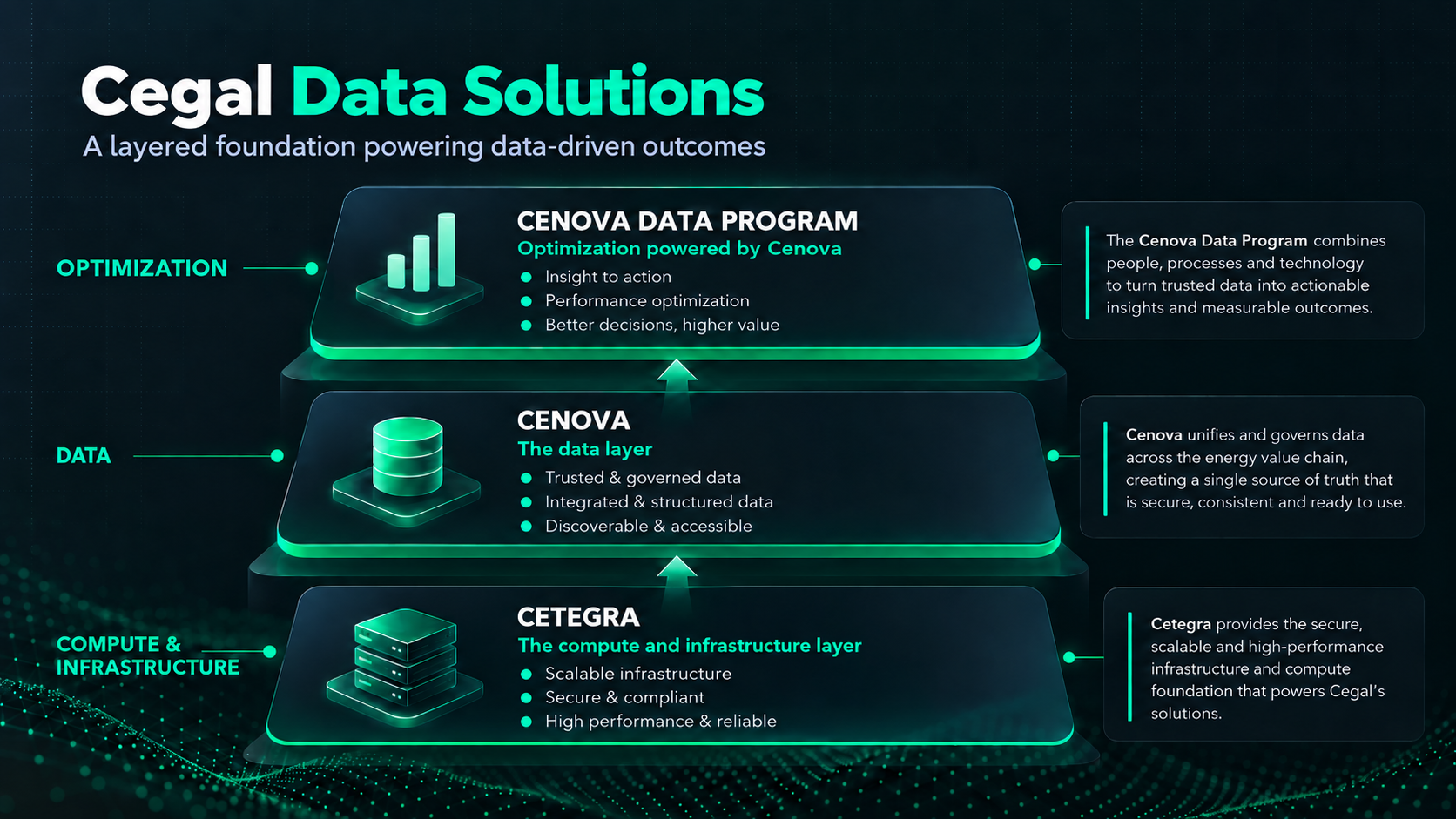
Cegal supports this through specialist services, supported by technology across each part of the estate: Cenova and the Cenova Data Program for technical and subsurface data, and Cetegra for secure application access and cloud operations. Together, these capabilities help organizations:
- understand what is transferring
- maintain secure access and operational continuity
- rationalize data, applications and infrastructure deliberately
- complete migrations and separations with clear ownership
- maintain governance after the transaction is complete
Turning integration into control
The cost of getting this wrong rarely appears as one dramatic failure. It emerges through delayed milestones, prolonged transition agreements, duplicated software and storage, interrupted workflows, repeated data clean-up and uncertainty over which information can be trusted. Getting it right means treating the technical estate as part of the deal from the beginning, not as an IT problem to solve afterwards.
One example comes from a Europe-based energy operator with a portfolio shaped by several acquisitions. Over time, its subsurface environment had become fragmented, with duplicated seismic volumes, interpretation projects spread across multiple locations, and inconsistent data models, folder structures and naming conventions.
Cegal crawled the environment to establish what existed, consolidated interpretation projects, centralized seismic data, removed unnecessary duplication and introduced common governance rules for metadata, formats and quality.
The result is a more consistent, governed environment that users across the organization can trust.
It illustrates the broader challenge: when deals move faster than data, completing the transaction is only part of the job. The new organization also needs to operate effectively from the moment ownership changes. Cegal combines energy-domain expertise, data management services and secure cloud technology to help operators remain in control before, during and after a transaction.
As consolidation across the energy sector continues, organizations that understand and govern their technical data estate early will be better positioned to realize value quickly, maintain operation continuity and build confidence in the new environment.
